The Business Growth Bottleneck Nobody Talks About: What Happens Between $1M and $10M
The real question isn't how to grow faster. It's what it would take for your business to run without you standing in the middle of it.

If your revenue has grown but working harder is what growth actually feels like, you've likely hit the growth ceiling: the point where a business built around one person's judgment can't keep scaling without that person becoming the bottleneck. It shows up as flat margin, decisions that still queue behind you, and a business you can't step away from, and it gets worse the more successful you become, not better. This article breaks down why growth multiplies owner dependency instead of relieving it, the signs you've hit this wall, and the shift that actually raises the ceiling.
You crossed a revenue number you used to dream about.
Maybe it was your first million, maybe it was three, and you expected it to feel like arriving.
Instead, you're working more hours than you did when the business was half the size, the profit doesn't seem to match the revenue on paper, and you have a private, disorienting thought you don't say out loud: growing the business made everything harder, not easier. If that's where you are, you've hit a ceiling that almost nobody names, and the silence around it is exactly why it's so confusing to run into.
There's a business growth bottleneck that shows up specifically in the stretch roughly between $250,000 and $10 million in revenue, and it has almost nothing to do with sales, marketing, or hiring. If your service business has grown past a million, you're squarely inside it. If you're still earlier, somewhere closer to $250,000 with a small team of three to six people, you're feeling the early edge of the same wall, even if it doesn't have a name yet. It's structural, it's predictable, and it gets worse the more successful you become, which is the part that makes it feel like something must be wrong with you.
What is the growth ceiling between $1M and $10M?
The growth ceiling is the point where the business has outgrown the way it's run, because every dollar of growth still has to pass through one person, and that person is you. It isn't a revenue problem or a hiring problem. It's what happens when a business built around one person's judgment keeps growing without ever changing what it depends on.
Quick Answer: The growth ceiling is what happens when a business keeps growing but the way it's run never changes, so every new client, hire, and decision still has to pass through the owner. Past a certain size, that single point of judgment becomes the thing that caps growth rather than the thing that built it.
Most advisors, when they see a business stalling at this stage, ask, "How do we grow revenue?" I ask the opposite question: "What breaks when you do?" In a founder-dependent business, growth doesn't relieve the pressure on the owner; it multiplies it because every new client, every new hire, and every new decision all route back through the same single point of judgment. You built the company by being the person who knows how everything should be done, and that worked beautifully up to a point. Past that point, being the operating system stops being your superpower and becomes the exact thing capping the company.
This is why the ceiling feels so strange.
The skills that got you here- personal involvement, high standards, being the one who catches everything- are the same skills that trap you now. Nobody warns you that the thing that built the business is the thing that will cap it, so when you hit the wall, you assume you need to work harder at what already worked, and working harder is precisely what makes the ceiling lower.
Why does growing make owner dependency worse?
Growing makes owner dependency worse because scale multiplies whatever the business depends on, and if the business depends on you, growth multiplies the demands on you faster than it multiplies your capacity.
This is the Illusion of Control at scale: the belief that staying close to everything keeps it safe, when, in practice, staying close to everything makes it impossible to grow past you.
Think about what actually happens when a founder-dependent business grows.
More clients means more relationships that expect your personal touch. More employees means more people waiting on your input before they can move. More revenue means more decisions, more exceptions, and more fires, all of which queue behind the same desk. Your capacity is fixed at twenty-four hours a day, but the demands on it scale with the business, so the larger you get, the more of a bottleneck you become.
This is the cruel arithmetic of owner dependency in a small business: the reward for growth is that the constraint tightens.
It doesn't announce itself as a crisis. It shows up as a slow realization that you can't take a real vacation, that your best people keep waiting for you instead of deciding for themselves, and that the business you built to give you freedom has quietly become the thing you can never step away from.
How do you know if your business has outgrown you?
You know your business has outgrown the way you run it when growth is creating more hours and more pressure rather than more freedom, and the pattern is clear enough that most owners recognize several signs at once.
If you're not sure whether you've hit this ceiling or you're just having a hard stretch, this is what it actually looks like.
Revenue has grown, but profit has stayed flat or even declined because the cost of holding everything together has climbed alongside sales.
You're working more hours than you did at half the size, not fewer, and you can't quite explain where the time goes.
Decisions still queue behind you, so the business moves at the pace of your availability rather than your team's.
You can't take a full week off without either the business stalling or your phone becoming a second office.
Your most capable people wait for your input on things they're clearly able to decide, because they've learned that acting without you is risky.
Quality still depends on your personal involvement, so scaling quality means cloning you, which isn't possible.
None of these are moral failings, and none of them mean you're doing it wrong.
They're the signature of a business that has grown past the systems that got it here, which is a good problem wearing an exhausting disguise. You built this business so that one day you'd finally have room to breathe, and somewhere in the growing you ended up with less room than you had five years ago. That gap between what you expected growth to feel like and what it actually feels like is the clearest sign of all that this is a systems ceiling, not a you problem.
What is the growth ceiling actually costing you?
The growth ceiling costs you far more than the hours you can already feel, because its most expensive effects hide in your margin and in what the business is worth without you. I spent more than twenty years as a controller before I did this work, so let me be specific about the money.
Quick Answer: The growth ceiling costs you in three places at once: your margin, because you're paying to compensate for the bottleneck with more hours and heavier oversight; your capacity, because the business is capped at the size of your calendar; and your enterprise value, because a business that can't run without you sells for far less than one that can.
Start with margin, because when every function still depends on the owner, you compensate for the bottleneck by working more and by hiring people who need heavy oversight, and both of those quietly compress your profit even as revenue climbs.
That's why so many owners at this stage are stunned to find that doubling revenue barely moved their take-home.
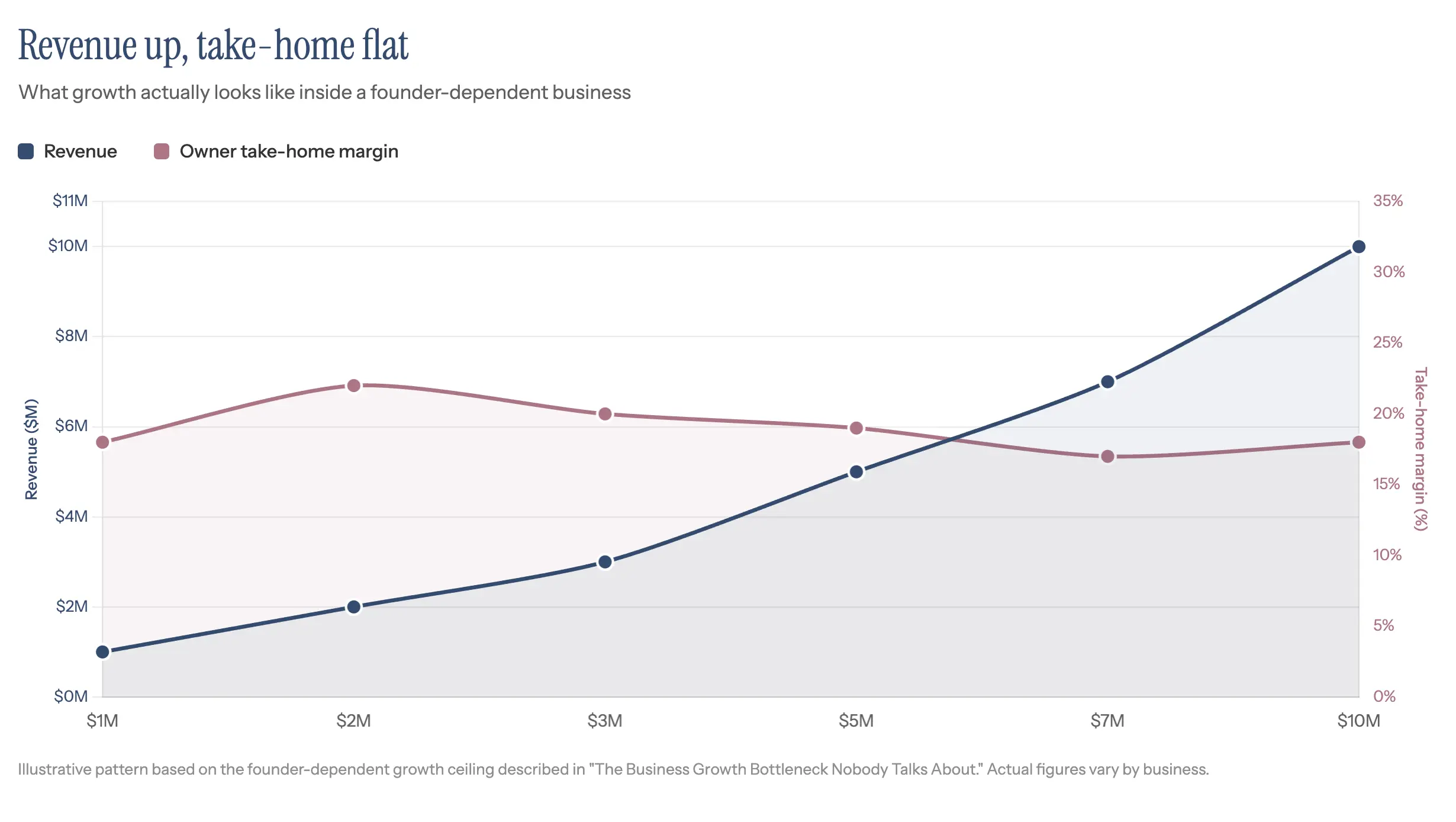
Then there's the ceiling on the business itself: a company that can only grow as fast as one person can personally execute is capped by the size of that person's calendar, and your calendar is already full. The highest cost, though, is the one owners discover last: a business that can't run without you is worth dramatically less when you want to sell it or step back, because you aren't selling a company, you're selling a job that requires you specifically.
The ceiling isn't just limiting this year's growth.
It's quietly limiting what the whole thing is worth.
How do you actually break through the growth ceiling?
You break through the growth ceiling by changing what the business depends on, not by working harder or hiring more, because both just pour more volume into the same bottleneck.
The shift is to move growth off of your personal judgment and onto systems and trusted decisions instead.
That shift is less dramatic than it sounds and more structural than a pep talk about letting go.
It starts with diagnosing where the business actually depends on you, honestly and specifically, because the dependence is rarely where owners assume it is. From there it moves to designing the decisions, standards, and boundaries that let work happen without your personal presence, and then to building those systems one deliberate piece at a time rather than in a single overwhelming overhaul, following the same diagnose, design, and build sequence at the heart of the methodology.
It's not fast, and it's not a hack, but it's the only thing that actually raises the ceiling because it addresses why the ceiling exists in the first place.
Why did my profit stay flat when my revenue grew?
Because in a founder-dependent business, the cost of holding everything together grows with the revenue. You absorb the growth with more of your own hours and with hires who need heavy oversight, and both quietly compress margin even as the top line climbs. Fixing that means changing what the business depends on, not just selling more.
Is this a sales problem or a systems problem?
Because in a founder-dependent business, the cost of holding everything together grows with the revenue. You absorb the growth with more of your own hours and with hires who need heavy oversight, and both quietly compress margin even as the top line climbs. Fixing that means changing what the business depends on, not just selling more.
Can my business run without me, or is that just a fantasy?
It can, but not by accident and not by hiring one more good person. It happens when the decisions, standards, and boundaries that currently live in your head get built into the business deliberately. The goal isn't your absence, it's that your presence stops being required for the ordinary work to happen well.
Do I need to be at a certain revenue for this to matter?
The ceiling tends to bite hardest as a business scales past a million, but the pattern starts much earlier, closer to the quarter-million mark with a team of just three to six people, and the sooner you address owner dependency the less painful it is. If growth is already making things harder instead of easier, you're feeling the ceiling regardless of the exact number on your P&L.
What's Next? Your Path from Here
If you recognize this pattern but aren't sure where the dependence actually lives in your business: Take the free Vital Signs Quiz, a ten-question diagnostic that shows you where your business is leaning hardest on your personal involvement, which is the honest starting point for raising the ceiling instead of working harder beneath it.
If the dependence you're feeling shows up most in what you can't hand off: Why Delegation Always Fails in Year One walks through the exact mechanism behind why the work keeps routing back to you, and what to build differently. [LINK: Why Delegation Always Fails in Year One]
You're not stuck because you're not working hard enough; you're stuck because the business outgrew the way you run it, and that is a solvable, structural problem.
Keep Reading

How to Delegate Without Losing Control (Or Your Mind)
You hired the person, trained them, and handed off the task, and still ended up redoing it yourself. That's not a delegation problem, it's a structure problem wearing a delegation costume. Here is a five-step system for handing off work without losing control of the outcome, plus a ten-minute prompt to test it on the one task you keep doing yourself.
Read More
The Vacation Test: The Fastest Way to Know If Your Business Is Too Dependent on You
If you can't take two weeks off without your business losing momentum, you don't have a delegation problem — you have a structural dependency. The Vacation Test is the fastest way to find out which type of dependency is driving it.
Read More
Why Delegation Always Fails in Year One (And What to Do Differently)
For most of my life, wealth meant a number on a spreadsheet, a portfolio size, a title on a business card. I was good at chasing it, until a quiet question started making itself heard: is this all there is? Here's the five-pillar framework I found on the other side of that question, and what it actually means to build a rich life instead of just a rich number.
Read More